《115-1_GHRM501_IB506_Organization Theory and Management》 Professor Matthew Liu on leadership and decision-making at critical moments
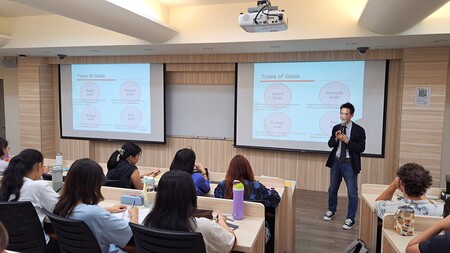
On September 29, 2026, the Organization Theory and Management course in the Global Human Resource Management (GHRM) and International Business (IB) MBA program at National Sun Yat-sen University (NSYSU), welcomed Professor Matthew Ting- Chi Liu from the University of Macau for a guest lecture on leadership and decision-making at critical moments. Born in Taiwan and having lived in Macao for more than two decades, Professor Liu drew on both academic concepts and practical examples to guide students in thinking about how leaders respond when organizations face uncertainty and difficult choices.
Professor Liu began by introducing Macao's development and its efforts to diversify beyond the gaming industry. From this example, he shifted the discussion toward leadership, explaining that leaders may need to respond differently depending on the situation. While normal conditions require leaders to provide direction, reduce uncertainty, and maintain organizational efficiency, critical moments call for stronger problem-solving and decision- making.
Shifting from theory to application, Professor Liu introduced the first case, Paradise Theme Park, a business facing financial difficulties while trying to preserve its long-standing value of fairness. Management was considering a preferred guest program that would allow customers who paid more to receive priority services, raising questions about whether the strategy could improve financial performance without weakening the company's core values. The case itself centers on whether differentiated service could save the business or undermine its positioning around fairness.
During the discussion, students interpreted fairness in different ways. Some argued that the company's survival had to be considered, while others suggested that fairness did not necessarily mean charging every customer the same price. As one student explained, “Maybe fairness is not that everybody pays the same, but that more people can afford to go to the park.” Students also proposed alternatives such as differentiated products, additional paid facilities, loyalty programs, and transportation services.
Professor Liu used the discussion to highlight that business strategies cannot simply be copied from other organizations. Even when a strategy succeeds elsewhere, leaders must still consider whether it fits their own organization's values, customers, and circumstances. The second case shifted the focus to creative problem-solving. Students were asked to manage a 50-floor office building where occupants complained about long elevator waiting times, while structural limitations made adding more elevators difficult. The case required students to look beyond the most obvious solution and consider other ways to reduce congestion and improve the user experience.
Students proposed a wide range of ideas, including escalators for lower floors, encouraging greater use of stairs, flexible working hours, hybrid work arrangements, internal cafeterias, elevator-arrival displays, smart scheduling algorithms, concierge services, and redesigned elevator systems. Rather than stopping at brainstorming, Professor Liu also asked students to consider which ideas were most practical and feasible, reinforcing the importance of evaluating solutions rather than simply generating them. Across both cases, Professor Liu encouraged students to move beyond straightforward answers. The Paradise Theme Park’s case required them to balance organizational values with financial pressure, while the elevator dilemma demonstrated how redefining a problem can lead to solutions that might otherwise be overlooked.
“When the company or the economy has some critical moments, the business leaders are expected to do more than what they are doing in the usual time.” — Professor Matthew Ting-Chi Liu
The two case discussions reflected this message by placing students in situations where conventional approaches were no longer sufficient. Through considering different perspectives, questioning initial assumptions, and comparing alternative solutions, the session emphasized that leadership in critical moments requires not only making decisions, but also understanding the situation carefully and finding responses that are both appropriate and workable. Written by: 蔡緗倫 Stanislaus Tjahjadi